For peo service teams
One client picture across HR, risk, payroll and benefits, with the receipts to prove the partnership.
Four disciplines meet the same client and each keeps its own notes. Routenna puts them on one timeline, so the handoff carries context and the renewal carries evidence.
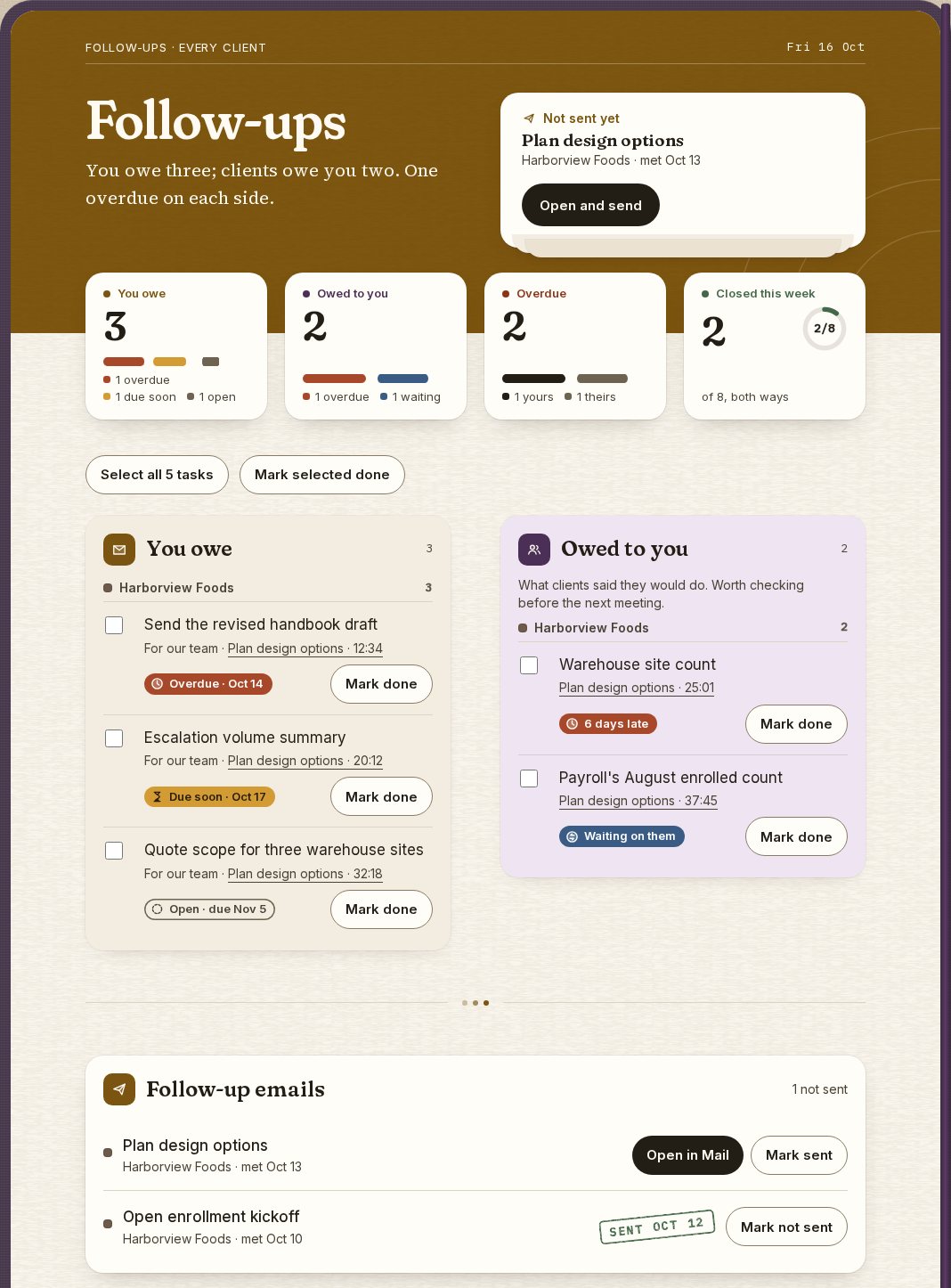
Real screen · fictional organization
Follow-ups: what you owe and what you are owed, overdue first.
Every screen on this site is the real product, shown with a fictional organization. No client data appears in any of them.
What goes wrong now
Three failures, in order of cost
Context is lost in cross-functional handoffs
The risk consultant learns something the payroll specialist needed a month ago. The client explains it a second time, and forms a view about the partnership while doing so.
Commitments are spread across disciplines
Every function owes the client something. No function can see the whole list, so nobody can answer what the client is actually waiting on.
Nothing proves the year at renewal
A year of real work exists as service tickets and recollection. The artifact that would make the renewal conversation easy is the one thing that never gets built.
What Routenna does about it
One engine
capture · extract · review
Meetings here mostly read as
- HR consultation
- Payroll review
- Benefits review
- Safety visit
- Claim coordination
Nobody chooses a mode: it is picked from the meeting’s title and record, and anything ambiguous is read as a general meeting. Capture, review, isolation, consent and deletion are the same for every one.
One service team runs several kinds of meeting, and each is read for its own: a safety visit and a benefits renewal are read differently, without anyone choosing which.
- One client timeline, every discipline on it
- Meetings, decisions, open commitments and unresolved concerns from all functions in one chronological record, scoped to your organization and nobody else’s.
- Handoffs inherit context, not recordings
- Whoever picks up the account reads the accumulated picture, with each claim linked to the transcript moment that proves it.
- Every discipline is one question away
- A service team splits HR, risk and benefits across people. The advisors do not: ask about a benefits call and the HR advisor answers the documentation problem it raised, whether or not an HR person was on it.
- A renewal artifact built continuously
- Recurring themes, commitments closed, concerns resolved. Assembled from the year as it happened rather than reconstructed the week before the meeting.
Nothing above writes itself into a client record. Commitments it is confident about count in your follow-ups automatically, and every one can be marked done, dismissed or undone. How follow-ups work.
What a finding looks like
No receipt, no render.
Every finding carries the transcript moment it came from, a confidence score, and an honest label: fact, inference or recommendation. Below the confidence threshold it is dropped rather than shown. A claim that cannot show where it was said does not appear.
Commitment
Proposed · awaiting review
“We’ll have the updated handbook draft to you before the renewal meeting.”
- Said at
- 00:14:32
- Speaker
- service consultant
- Confidence
- 0.86
- Label
- Fact
Getting started
Run it on the meetings you already have.
Routenna is built for PEO service teams working across disciplines. Terms are agreed in writing before anything records, and the plans and their prices are on the site rather than behind a call.