For benefits brokers
Renewals, service issues and cross-sell signals, captured as they are said.
The renewal conversation that matters happened in March, in passing, in a service call. Routenna catches it there instead of in October when the census is already due.
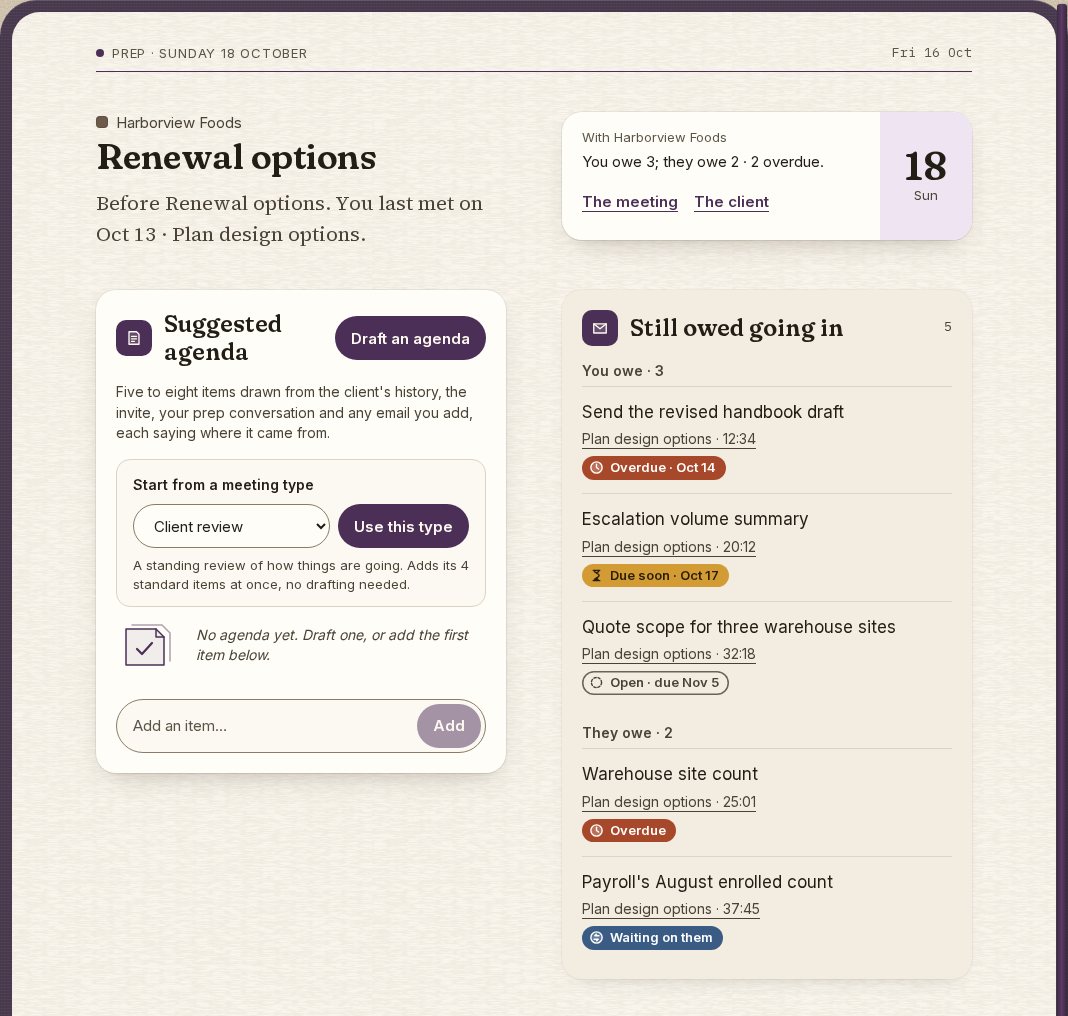
Real screen · fictional organization
Prep for the next meeting: a suggested agenda and what is still owed going in.
Every screen on this site is the real product, shown with a fictional organization. No client data appears in any of them.
What goes wrong now
Three failures, in order of cost
Renewal cycles arrive faster than the prep
The context that should shape the renewal was spread across eleven months of calls, and gathering it starts three weeks out from a deadline that has not moved since last year.
Service promises get lost between meetings
You said you would chase the carrier, re-run the contribution model, get the enrollment materials over. Each one lived in one conversation and nowhere else.
Opportunities are heard and never followed
A client mentions an acquisition, a new state, a class of employee they have never covered. It registers in the moment and is gone by the drive home.
What Routenna does about it
One engine
capture · extract · review
Meetings here mostly read as
- Benefits review
- Client review
- Discovery
Nobody chooses a mode: it is picked from the meeting’s title and record, and anything ambiguous is read as a general meeting. Capture, review, isolation, consent and deletion are the same for every one.
A renewal, or a conversation about what employees are asking for, is read as a benefits review; a standing check-in as a client review.
- Renewal context accumulates all year
- Every service call, every complaint, every question about plan design lands on the same client timeline. The renewal brief is assembled from twelve months of evidence, not three weeks of recall.
- Promises become tracked commitments
- What you committed to, in your own words, with the timestamp. Open until someone marks it done.
- A risk read on a benefits conversation
- Ask a question about a meeting and each advisor it calls for answers on its own. The one worth having on a renewal call is the risk read: a census change or a classification question raised in passing is the kind of thing that turns into a claim coordination problem months later, and it points at the moment it was said.
- Signals are surfaced as findings, not as trivia
- An expansion, an acquisition, a headcount change or a competitor mention is extracted as an opportunity or a signal and put in front of you, labeled honestly as fact or inference.
Nothing above writes itself into a client record. Commitments it is confident about count in your follow-ups automatically, and every one can be marked done, dismissed or undone. How follow-ups work.
What a finding looks like
No receipt, no render.
Every finding carries the transcript moment it came from, a confidence score, and an honest label: fact, inference or recommendation. Below the confidence threshold it is dropped rather than shown. A claim that cannot show where it was said does not appear.
Opportunity
Proposed · awaiting review
“We’re opening the Nevada office in Q3: probably twenty people to start, maybe more.”
- Said at
- 00:12:05
- Speaker
- client HR director
- Confidence
- 0.88
- Label
- Fact
Getting started
Run it on the meetings you already have.
Routenna is built for insurance and benefits brokers. Terms are agreed in writing before anything records, and the plans and their prices are on the site rather than behind a call.